

Recent Products
-
 Pineapple Guava Seedlings (Feijoa) Original price was: KSh 7,000.00.KSh 3,500.00Current price is: KSh 3,500.00.
- Delight Lucerne Seeds Original price was: KSh 3,000.00.KSh 2,650.00Current price is: KSh 2,650.00.
- Turmeric Seedlings Original price was: KSh 250.00.KSh 150.00Current price is: KSh 150.00.
- Ginger Seedlings Original price was: KSh 200.00.KSh 150.00Current price is: KSh 150.00.
- Molasses KSh 1,500.00
- Biofix Soybean Inoculant (150g) Original price was: KSh 1,650.00.KSh 1,500.00Current price is: KSh 1,500.00.
- Biofix Beans Inoculant (100g) Original price was: KSh 1,400.00.KSh 1,350.00Current price is: KSh 1,350.00.
- Biofix French Bean Inoculant (100g) Original price was: KSh 1,500.00.KSh 1,450.00Current price is: KSh 1,450.00.
- Biofix Lucerne Inoculant (100g) Original price was: KSh 1,600.00.KSh 1,450.00Current price is: KSh 1,450.00.
- Biofix French Beans Inoculant (150g) Original price was: KSh 1,650.00.KSh 1,500.00Current price is: KSh 1,500.00.


On Sale Products
- Canistel / Egg Fruit Seedlings Original price was: KSh 5,000.00.KSh 3,000.00Current price is: KSh 3,000.00.
- Bitter Leaf Seedlings Original price was: KSh 180.00.KSh 150.00Current price is: KSh 150.00.
- Amistar fungicide Original price was: KSh 5,000.00.KSh 4,650.00Current price is: KSh 4,650.00.
- Milking Machine Original price was: KSh 85,000.00.KSh 79,500.00Current price is: KSh 79,500.00.
- Lynfield Trap Original price was: KSh 950.00.KSh 850.00Current price is: KSh 850.00.
- Custard Apple Seedlings Original price was: KSh 500.00.KSh 350.00Current price is: KSh 350.00.
- Grafted Pixie Orange Seedlings Original price was: KSh 350.00.KSh 250.00Current price is: KSh 250.00.
- Hass Avocado Farming Package Original price was: KSh 75,000.00.KSh 65,000.00Current price is: KSh 65,000.00.
- Grafting Knife Original price was: KSh 550.00.KSh 480.00Current price is: KSh 480.00.
- Roux Automatic Syringe 50ml Original price was: KSh 9,850.00.KSh 9,550.00Current price is: KSh 9,550.00.
- Pixie Orange Farming Package Original price was: KSh 110,000.00.KSh 89,600.00Current price is: KSh 89,600.00.


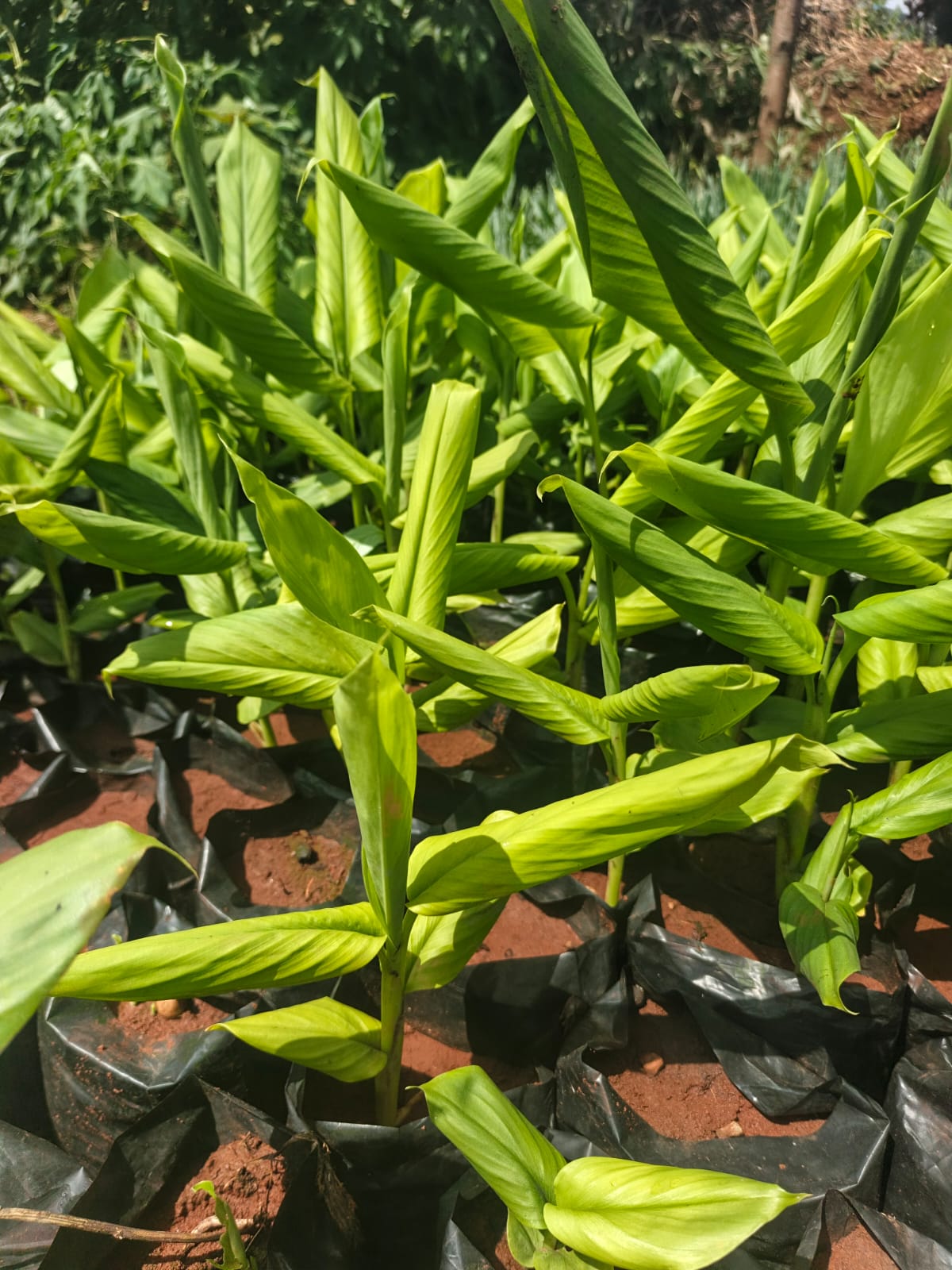
Turmeric Seedlings
Original price was: KSh 250.00.KSh 150.00Current price is: KSh 150.00.
Turmeric farming in Kenya is not a get-rich-quick scheme. It takes work, knowledge, and investment. But for the farmers who do it right, the rewards are real. A well-managed acre of high-curcumin turmeric can generate KES 1,000,000 or more in profit.
Start with the right seedlings. Prepare your land properly. Build raised beds. Install drip irrigation. Follow the growth calendar. Watch for pests and diseases. Harvest at the right time. Process for export.
Farmers Trend Limited is here to help you at every step. From certified seedlings to soil testing to market linkage, we provide the tools you need to succeed.
Order your certified high-curcumin turmeric rhizomes today.
Call 0790509684
Turmeric Seedlings in Kenya: The 2026 Authority Guide to Commercial Production and Export Profit

Quick Summary
Turmeric is the “New Gold” for Kenyan farmers. One acre of commercial turmeric can generate KES 800,000 to KES 1,500,000 in profit within 8 to 9 months. Market-bought turmeric from local markets fails 50-80% of the time due to disease and sprout inhibitors. Certified, high-curcumin seedlings from Farmers Trend Limited are your only path to export-grade production. We operate certified nurseries in Murang’a, Ruiru and Muthaiga, Nairobi, producing hardened, disease-free turmeric rhizomes ready for immediate planting.
Part One: The Turmeric Boom. Why This Crop Is the New Gold for Kenyan Farmers.
Turmeric has transformed from a little-known spice into one of the most profitable cash crops in Kenya. The global demand for turmeric continues to rise, driven by health consciousness and the growing popularity of golden milk, turmeric teas, and natural remedies. Kenyan farmers who entered this space early are already reaping substantial returns.
The local market for turmeric in Kenya is expanding rapidly. Supermarkets in Nairobi, Mombasa, Kisumu, and Nakuru now stock fresh turmeric roots alongside ginger. Health food stores sell turmeric powder and capsules at premium prices. Juice bars add fresh turmeric to their wellness shots. Traditional medicine practitioners rely on turmeric for its anti-inflammatory properties.
The export potential is even larger. European, Middle Eastern, and Asian buyers are actively looking for African turmeric suppliers. They want clean, disease-free rhizomes with high curcumin content. Kenyan turmeric can meet this standard, but only if farmers use certified seedlings rather than market-bought rhizomes.
Market-Bought Turmeric. A Failed Business Model.
Here is a hard truth that many farmers learn too late. Using turmeric bought from the local market as planting material is a gamble you will likely lose. The turmeric you buy from Mama Mboga has already been harvested, handled, transported, and stored under unknown conditions. It may carry rhizome rot, nematodes, or fungal diseases that will infect your entire field.
Market turmeric has also been treated with sprout inhibitors to keep it from germinating on the shelf. These same inhibitors prevent your planted rhizomes from sprouting in the soil. You will wait weeks or months with nothing coming up, and by the time you realize the problem, your planting season is gone.
Certified turmeric seedlings in Kenya are the only path to profit. These are specially grown rhizomes that have been inspected, treated, and certified as disease-free. They sprout uniformly. They grow vigorously. They give you the yield you need to make real money.

A farmer from Kirinyaga brought us a sample of his “planting turmeric” bought from a local market. The rhizomes were wrinkled and had soft brown spots. We cut one open and found the flesh was grey, not orange. We told him this turmeric would rot in the ground. He planted it anyway. Two months later, he called us asking why only 20 percent of his crop had sprouted. The rest had turned to mush. This is what we see every week at our nursery.
The Market Potential You Cannot Ignore.
Kenya currently produces only a fraction of the turmeric it consumes. The rest is imported from India, Nepal, and China. This import bill represents an opportunity for local farmers. Every kilogram of turmeric you produce displaces an imported kilogram, and the market is willing to pay for quality.
Wholesale prices for fresh turmeric in Kenya range from KES 80 to KES 150 per kilogram depending on the season. Processed turmeric powder sells for KES 400 to KES 800 per kilogram. Export markets pay premium rates for certified high-curcumin turmeric, sometimes reaching KES 200 per kilogram or more for fresh roots.
The numbers add up quickly. A well-managed acre of commercial turmeric farming can produce 8 to 12 tons of fresh rhizomes. At KES 100 per kilogram, that is KES 800,000 to KES 1,200,000 in revenue. Your production costs are typically KES 300,000 to KES 400,000 per acre, leaving you with a healthy profit margin.
Table 1: Turmeric Market Price Matrix in Kenya (2026)
| Market Channel | Fresh Turmeric (KES/kg) | Dried Turmeric Powder (KES/kg) | High-Curcumin Export (KES/kg) |
|---|---|---|---|
| Local open market | 80 – 100 | 400 – 600 | Not applicable |
| Supermarkets | 100 – 150 | 600 – 800 | Not applicable |
| Export (direct) | 120 – 180 | 800 – 1,200 | 200 – 300 |
| Export (certified organic) | 180 – 250 | 1,000 – 1,500 | 300 – 500 |
Part Two: Technical Agronomy for Kenya. Growing Turmeric the Right Way.
Turmeric is not a difficult crop to grow, but it is unforgiving of mistakes. Get the basics right and you will be rewarded with heavy yields. Get them wrong and you will harvest nothing but rot and disappointment.
Soil Requirements That Make or Break Your Crop.
Turmeric needs loose, well-draining soil. The rhizome grows underground, and if the soil is hard or compacted, the rhizome cannot expand. You will harvest small, twisted fingers instead of plump, straight rhizomes.
The ideal soil pH for turmeric seedlings in Kenya is 6.0 to 6.5. Below 6.0, the soil is too acidic and nutrients become unavailable. Above 7.0, the soil is too alkaline and micronutrients get locked up. You must test your soil before planting and correct the pH if needed.
Sandy loam or loamy soil is the best choice for turmeric. This soil type drains quickly after rain, preventing water from pooling around the rhizomes. It is also loose enough for the rhizomes to expand easily. Heavy clay soils are a poor choice because they hold water and become hard when dry.
Regional Advice for Kenyan Farmers.
- Coast Region (Kilifi, Lamu, Kwale, Tana River): The coastal climate is hot and humid, which turmeric loves. However, the sandy soils drain too quickly and lack organic matter. You must add plenty of manure and compost to build soil fertility. Raised beds are essential here to prevent waterlogging during the heavy rains. The long rainy season from March to July is your best planting window.
- Lake Region (Migori, Homa Bay, Kisii, Busia): These areas have fertile volcanic soils that are excellent for turmeric. The rainfall is reliable, but the soils can become waterlogged. Build raised beds at least 25 centimeters high. The main challenge here is nematodes, which are common in these soils. Solarize your beds before planting and rotate with marigolds.
- Central and Mt Kenya Lowlands (Murang’a, Kirinyaga, Embu, Meru, Tharaka Nithi): These areas have deep, well-draining soils that are ideal for turmeric. The temperatures are moderate, and the rainfall is well-distributed. This is where Farmers Trend Limited operates our main nursery. Farmers here have the advantage of being close to our technical support team. The main challenge is the cold nights in higher altitude areas. Plant in March so the crop matures before the cold June nights.
We have tested turmeric at our demo plots in different regions. The best yields come from Murang’a and Embu, where the soil is deep and the rainfall is reliable. The coast gives good yields but requires more water because the sandy soils dry out faster. The lake region gives moderate yields but has higher nematode pressure. Choose your location based on your ability to manage water and pests.
The Raised Bed Mandate. Why Ridge or Bed Planting Is Non-Negotiable.
Raised beds are not optional for commercial turmeric farming in Kenya. They are a requirement for success, especially in areas with moderate to high rainfall. A raised bed lifts the rhizome above the surrounding ground level, allowing water to drain away from the plant rather than pooling around it.
Build your beds 20 to 30 centimeters high and 1 meter wide. Leave a path of 40 to 50 centimeters between beds for walking and working. The length of the bed can be whatever fits your land, but keep it under 20 meters for easy management.
The beds should run along the contour of your land to prevent erosion. If your land is flat, orient the beds north to south to maximize sunlight exposure. If your land slopes, run the beds across the slope to catch water and prevent runoff.
Before planting, incorporate plenty of well-decomposed manure into the beds. Turmeric is a heavy feeder, and manure provides slow-release nutrients that feed the crop throughout the season. Use 10 to 15 tons of manure per acre, mixed into the top 15 to 20 centimeters of soil.
We have tested raised beds of different heights at our demo plot in Murang’a. Beds that are 15 centimeters high still got waterlogged during the heavy March rains. Beds that are 25 centimeters high drained perfectly. The extra 10 centimeters of height cost more labor but saved the crop. Do not build low beds if you are in a high rainfall area.
Part Three: Variety Selection. The Foundation of Your Turmeric Farm.
The variety you choose determines your yield, your curcumin content, and your market price. Not all turmeric is the same. Some varieties are bred for high yield, others for high curcumin, and others for disease resistance.
The Top-Performing Varieties for the Kenyan Market.
- High-Curcumin Red Turmeric is the most valuable variety for export markets. It contains 5 to 7 percent curcumin, compared to 2 to 3 percent in standard varieties. The rhizomes are darker orange inside and have a stronger aroma. The yield is moderate at 8 to 10 tons per acre, but the price per kilogram is significantly higher. This variety takes 8 to 9 months to mature.
- Local Yellow Turmeric is the traditional Kenyan variety. The curcumin content is lower at 2 to 3 percent, but the yield is higher at 10 to 12 tons per acre. The flavor is milder, making it suitable for local fresh markets. This variety matures faster at 7 to 8 months.
- Alleppey Supreme is a variety from India that has been adapted to Kenyan conditions. It has curcumin content of 4 to 5 percent and good yield potential of 9 to 11 tons per acre. The rhizomes are long and plump with deep orange flesh. This variety is popular with both local processors and export buyers.
The Danger of Using Market-Bought Turmeric.
Market-bought turmeric is not suitable for planting. Here is why.
First, you do not know the variety. It could be a low-curcumin variety that will not attract export buyers. Second, you do not know the disease status. The rhizomes may carry bacterial wilt, fusarium, or nematodes. Third, you do not know if the rhizomes have been treated with sprout inhibitors. Many traders spray their turmeric to prevent sprouting on the shelf. These same chemicals prevent sprouting in your field.
A farmer from Kiambu bought 500 kilograms of turmeric from a trader in Nairobi. He paid KES 70 per kilogram, thinking he was getting a good deal. He planted the whole acre. After 8 weeks, only 30 percent had sprouted. The rest had rotted in the ground. He lost KES 35,000 on seed and KES 40,000 on labor and fertilizer. Cheap seed is expensive in the long run.
Why Farmers Trend Limited’s Certified Rhizomes Are the Only Safe Choice.
At Farmers Trend Limited, our certified turmeric rhizomes are grown specifically for planting, not for eating. We harvest them at the right time for maximum sprouting potential. We treat them with biological fungicide to prevent soil-borne diseases. We store them in cool, well-ventilated conditions to preserve their viability.
Our seedlings are hardened before they leave our nursery. Hardening is a process where we gradually expose the seedlings to outdoor conditions so they adapt to the environment. This reduces transplant shock and improves survival rates.
Each seedling unit is priced competitively. The cost may seem higher than market turmeric, but the value is incomparable. You get uniform sprouting, faster growth, higher yields, and fewer disease problems.
Table 2: Certified Seedlings vs. Market-Bought Turmeric Comparison
| Factor | Certified Seedlings (Farmers Trend) | Market-Bought Turmeric |
|---|---|---|
| Sprouting rate | 95% to 100% | 20% to 50% |
| Disease incidence | Low (treated) | High (unknown) |
| Curcumin content | Known (3-7%) | Unknown (1-3%) |
| Uniformity of growth | High | Low |
| Yield potential (tons/acre) | 8 to 12 | 3 to 5 |
| Cost per acre (approx) | KES 120,000 – 150,000 | KES 40,000 – 60,000 |
| Net profit per acre | KES 600,000 to 1,200,000 | KES 100,000 to 200,000 |

Part Four: The 2026 Commercial Roadmap. Month by Month to Harvest.
This roadmap takes you from bare ground to full harvest. Follow each step carefully, and do not skip ahead. Turmeric rewards attention to detail and punishes shortcuts.
Planting Phase. Land Preparation and Planting.
Start preparing your land at least two months before planting. Deep rip the soil to 40 to 50 centimeters to break up compacted layers. Plough and harrow to create a fine seedbed. Remove stones, roots, and debris.
Build raised beds 20 to 30 centimeters high and 1 meter wide. Incorporate 10 to 15 tons of well-decomposed manure per acre into the top 15 to 20 centimeters of soil.
The best time to plant turmeric in Kenya is at the start of the rainy season. For most regions, this means March to April for the long rains or October to November for the short rains.
Cut your certified turmeric rhizomes into pieces. Each piece should have at least two buds or eyes and weigh 30 to 50 grams. Larger pieces produce stronger plants.
The planting spacing is 30 centimeters between plants within the row and 15 centimeters between rows. This spacing gives each plant enough room to develop.
Plant each piece 5 to 7 centimeters deep, with the buds pointing upward. Cover with loose soil and press down gently. Apply a layer of dry grass or straw mulch 5 to 10 centimeters thick over the planted beds.
Table 3: Turmeric Planting Parameters
| Parameter | Recommendation | Notes |
|---|---|---|
| Seed piece size | 30 to 50 grams | 2 to 3 buds per piece |
| Spacing (within row) | 30 cm | Wider for larger varieties |
| Spacing (between rows) | 15 cm | Closer for higher population |
| Planting depth | 5 to 7 cm | Deeper in sandy soils |
| Seed rate per acre | 800 to 1,000 kg | Depends on seed piece size |
| Plant population per acre | 80,000 to 100,000 | 30cm x 15cm spacing |
Growth Phase. Nutrient and Water Management.
Turmeric needs consistent moisture during the first 5 months of growth. Drip irrigation is the best method because it delivers water directly to the soil without wetting the leaves.
Apply the first top dressing of fertilizer at 6 weeks after planting. Use NPK 23:23:23 at 100 kg per acre. Apply the second top dressing at 3 months. Use NPK 17:17:17 at 150 kg per acre. Apply the third top dressing at 5 months. Use Sulphate of Potash at 100 kg per acre to improve rhizome quality and curcumin content.
Mulch heavily to conserve moisture, suppress weeds, and keep the soil cool. Replenish the mulch layer as it breaks down.
Maturation Phase. Signs of Harvest Readiness.
Turmeric is ready for harvest when the leaves turn yellow and start to dry. This typically happens 8 to 9 months after planting.
Stop watering 2 to 3 weeks before harvest to allow the soil to dry. The rhizomes will have developed their full color, aroma, and curcumin content.
Harvest on a dry, sunny day. Use a garden fork to loosen the soil around the plants. Lift gently. Shake off the loose soil. Do not wash the rhizomes unless you are processing them immediately.
The last month of growth is when the curcumin content increases most rapidly. A field harvested at 7 months may have 3 percent curcumin. The same field harvested at 9 months may have 5 percent curcumin. Those extra two months can double your export price. Do not harvest early.
Before you plant, compare your soil profile with our [National Farmers Database soil-suitability map]. Register your farm here to access customized recommendations for your specific location.
Part Five: Pest and Disease Masterclass. Protecting Your Investment.
Turmeric has several serious enemies in the soil and the air. You cannot eliminate all risks, but you can manage them to keep your crop healthy.
The Main Threats to Commercial Turmeric Farming.
- Rhizoctonia Rot is a fungal disease that attacks the rhizomes. It causes dark, sunken lesions on the rhizome surface. The affected tissue becomes dry and cracked. The plant above ground may look healthy until you harvest. Prevention includes using certified disease-free seedlings, raised beds, and crop rotation.
- Leaf Spot is caused by the fungus Colletotrichum. Small yellow spots appear on the leaves. The spots enlarge and turn brown with yellow halos. Severe infection causes leaf death and reduced yield. Prevention includes good air circulation, avoid overhead watering, and copper-based fungicides.
- Nematodes are microscopic worms that live in the soil and feed on turmeric roots. They cause galls or knots on the roots. The plant becomes stunted and yellow. Prevention includes soil solarization, planting marigolds as a trap crop, and using certified seedlings.
Report any field outbreaks to our [Farmers Trend Agri-Alert System] for real-time diagnostic support. Register your farm here to receive immediate alerts when diseases are reported in your region.
Table 4: Turmeric Pest and Disease Mitigation Table
| Problem | Causal Agent | Symptoms | Prevention | Treatment |
|---|---|---|---|---|
| Rhizoctonia Rot | Rhizoctonia solani | Dark lesions on rhizomes | Certified seedlings, raised beds, drainage | Remove infected plants |
| Leaf Spot | Colletotrichum | Yellow spots on leaves | Good air circulation, avoid overhead water | Copper-based fungicides |
| Nematodes | Root-knot nematodes | Stunted growth, galls on roots | Soil solarization, marigolds | Nematicides (limited) |
| Bacterial Wilt | Ralstonia | Sudden wilting, white ooze | Certified seedlings, crop rotation | No cure. Remove and destroy. |
Part Six: Financials and Export Standards. The Numbers You Need to Know.
Let us put real numbers on the page. These figures are based on current market prices and input costs in Kenya.
One-Acre Cost-Benefit Analysis.
Costs Per Acre.
Land preparation: KES 15,000 to KES 25,000
Certified seedlings: KES 120,000 to KES 150,000 (800 to 1,000 kg)
Fertilizers and amendments: KES 50,000 to KES 70,000
Labor: KES 50,000 to KES 70,000
Irrigation (drip installation): KES 80,000 to KES 120,000 (one-time)
Pest and disease control: KES 15,000 to KES 25,000
Mulch: KES 10,000 to KES 20,000
Total cost per acre: KES 340,000 to KES 480,000
Revenue Per Acre.
Target yield: 8 to 12 tons per acre
Fresh market price: KES 80 to KES 150 per kilogram (average KES 100)
Fresh turmeric revenue: KES 800,000 to KES 1,200,000
Export market revenue (high-curcumin): KES 1,200,000 to KES 2,400,000
Profit Per Acre.
Fresh market profit: KES 460,000 to KES 760,000
Export market profit: KES 860,000 to KES 1,900,000
Table 5: One-Acre Turmeric Financial Summary (2026)
| Scenario | Yield (tons) | Revenue (KES) | Costs (KES) | Profit (KES) | ROI (%) |
|---|---|---|---|---|---|
| Beginner (fresh) | 8 | 800,000 | 340,000 | 460,000 | 135% |
| Experienced (fresh) | 12 | 1,200,000 | 400,000 | 800,000 | 200% |
| Export (high-curcumin) | 8 | 1,600,000 | 450,000 | 1,150,000 | 256% |
| Export (certified organic) | 10 | 2,500,000 | 500,000 | 2,000,000 | 400% |
The Export-Ready Checklist.
To sell turmeric to international buyers, you must meet their quality standards. Here is what they look for.
Curcumin content. Standard turmeric has 2-3 percent curcumin. Export buyers want 5 percent or higher. High-curcumin red turmeric can reach 6-7 percent. This is what Farmers Trend Limited provides.
Cleanliness. The rhizomes must be free from soil, dirt, and debris. Wash them before drying. Use clean water and dry them thoroughly.
Size and shape. Buyers prefer plump, uniform rhizomes with no splits or cracks. Sort your harvest by size. The largest rhizomes get the best prices.
Drying and curing. Export turmeric is usually dried to 10-12 percent moisture content. You can sun-dry on clean tarpaulins or use a mechanical dryer. Turn the rhizomes regularly for even drying. Do not overdry, or the rhizomes become brittle.
Grading. Grade your turmeric by size, color, and quality. Grade A is the largest, cleanest rhizomes with deep orange color. Grade B is smaller or slightly damaged. Grade C is for processing into powder.
Certification. Export buyers require phytosanitary certificates and sometimes organic certification. Farmers Trend Limited can guide you through the certification process.
A farmer we work with in Embu grew high-curcumin red turmeric on one acre. He got 9 tons of fresh rhizomes. He dried them and sold to an exporter at KES 300 per kilogram for dried turmeric. His revenue was KES 1,800,000. His costs were KES 450,000. His profit was KES 1,350,000. This is what is possible with the right seedlings and the right market.
High-Conversion Offer Box
Ready to Secure Your 2026 Turmeric Harvest?
Don’t gamble with market-bought rhizomes. Secure your Certified High-Curcumin Turmeric Seedlings directly from our Murang’a and Muthaiga nurseries.
When you order from Farmers Trend Limited, you get:
Get a custom quote for your acreage
Get our free “2026 Commercial Turmeric Planting Kit” (PDF Guide)
Access to our agronomist support team for the entire season
👉 Talk to an Agronomist on WhatsApp
👉 Register Your Farm in National Database
Visit Our Nurseries. Get Your Seedlings Directly from the Source.
Farmers Trend Limited operates two certified seedling centers in Kenya. You are welcome to visit either location to inspect our seedlings before you buy.
Muthaiga Nursery: Located next to the Golf Course, Nairobi. Our Muthaiga site serves farmers from Nairobi, Kiambu, Kajiado, and Machakos. Open Monday to Saturday, 8 AM to 5 PM.
Murang’a Nursery: Located along the Nairobi-Embu Highway at Kwa Samaki. Our Murang’a site serves farmers from Murang’a, Kirinyaga, Embu, Meru, and Tharaka Nithi. This is our main production nursery where we harden our high-curcumin red turmeric seedlings.
Why visit us in person? You can see the seedling quality with your own eyes. You can speak directly with our agronomists. You can collect your seedlings immediately without waiting for delivery.
Call before you visit: 0790509684
Part Seven: The Farmers Trend Advantage. Why We Are the #1 Source.
Farmers Trend Limited operates certified nurseries in Murang’a and Muthaiga, Nairobi. We have spent years developing the systems and expertise that make us the leading supplier of turmeric seedlings in Kenya.
Our Nursery Expertise.
We source our foundation stock from disease-free mother plants with verified high-curcumin content. These plants are grown in isolated beds and inspected regularly. Only the healthiest rhizomes are selected for multiplication.
Our seedlings are grown in dedicated seed plots that have never grown turmeric before. The soil is tested regularly for pH, nutrients, and pathogens.
At harvest, our seedlings are handled with care to prevent bruising. They are treated with biological fungicide. They are hardened for 14 days before sale, meaning they are gradually exposed to outdoor conditions so they adapt to your farm.
Why Farmers Should Register in Our National Farmers Database.
When you buy from Farmers Trend Limited, you are invited to register in our National Farmers Database. This gives you access to market linkages, technical support, and seasonal planting alerts.
We connect our registered farmers with buyers including local supermarkets, processors, and export agents. We share market price updates so you know when to sell. We provide training and troubleshooting support throughout the growing season.
Register now: Click here to add your farm to our National Farmers Database
Our Call to Action.
Do not plant another turmeric seed until you have the right seedlings. Market turmeric is a gamble you cannot afford to take.
Order your certified high-curcumin turmeric rhizomes from Farmers Trend Virtual Agrovet.
Call us at 0790509684. Message us on WhatsApp. Visit our nurseries in Murang’a or Muthaiga.
Your Next Steps in Turmeric Farming.
Turmeric farming in Kenya is not a get-rich-quick scheme. It takes work, knowledge, and investment. But for the farmers who do it right, the rewards are real. A well-managed acre of high-curcumin turmeric can generate KES 1,000,000 or more in profit.
Start with the right seedlings. Prepare your land properly. Build raised beds. Install drip irrigation. Follow the growth calendar. Watch for pests and diseases. Harvest at the right time. Process for export.
Farmers Trend Limited is here to help you at every step. From certified seedlings to soil testing to market linkage, we provide the tools you need to succeed.
Order your certified high-curcumin turmeric rhizomes today.
Call 0790509684 | WhatsApp | Visit Murang’a or Muthaiga Nursery
Join the turmeric revolution. Register in the Farmers Trend National Farmers Database to receive seasonal planting alerts, market price updates, and exclusive access to seedling discounts. Your first step to profitable turmeric farming starts here.
For more detailed technical information, download our full guide: Turmeric Farming in Kenya 2026 Guide
General Inquiries
There are no inquiries yet.
Related products
Marjoram Seedlings
KSh 200.00Add to cartMarjoram Seedlings 🌿
Boost your farming income with our high-quality marjoram seedlings, available at just Ksh 200 per seedling. Fast-growing, disease-free, and aromatic, these seedlings are perfect for culinary adventures, medicinal uses, and profitable farming. Start your agribusiness journey today and enjoy the benefits of this versatile herb! 🌱Mint Seedlings
KSh 150.00Select options This product has multiple variants. The options may be chosen on the product pageMint Seedlings – 150 KSH
Refresh your farming journey with Mint Seedlings from Farmers Trend Virtual Agrovet! At just 150 KSH per seedling, you can grow a variety of Mint types, including Peppermint, Chocolate Mint, Tropical Mint, Apple Mint, Spearmint, Spanish Mint, Double Mint, Strawberry Mint, Pineapple Mint, and Ginger Mint. Perfect for Kenyan climates, Mint thrives in well-drained soils and partial sunlight, yielding up to 2,000–3,000 kg of fresh leaves per acre. With high demand in local and export markets, Mint farming offers a lucrative opportunity for farmers. Order your seedlings today and unlock the potential of this versatile herb!Bitter Leaf Seedlings
Original price was: KSh 180.00.KSh 150.00Current price is: KSh 150.00.Add to cartBitter Leaf Seedlings 🌿
Boost your farming income with our high-quality bitter leaf seedlings, available at just Ksh 150 per seedling. Fast-growing, disease-free, and high-yielding, these seedlings are ideal for profitable bitter leaf farming in Kenya. Start your agribusiness journey today and tap into the growing demand for bitter leaf in local and international markets! 🌱Terragon Seedlings
Original price was: KSh 250.00.KSh 200.00Current price is: KSh 200.00.Add to cartTarragon Seedlings
Grow your way to culinary and financial success with Tarragon Seedlings from Farmers Trend Virtual Agrovet! At just 200 KSH per seedling, you can start cultivating this high-value herb, known for its rich flavor and medicinal benefits. Perfect for Kenyan climates, Tarragon thrives in well-drained soils and full sunlight, yielding up to 2,000–3,000 kg of fresh leaves per acre. With high demand in local and export markets, Tarragon farming offers a lucrative opportunity for farmers. Order your seedlings today and unlock the potential of this versatile herb!


Featured Products
- Knapsack Sprayer Pump Price range: KSh 3,900.00 through KSh 8,250.00
- Metallic Garden Rake with Handle Original price was: KSh 2,400.00.KSh 1,200.00Current price is: KSh 1,200.00.
- Coopers Triatix Stock Spray Price range: KSh 107.00 through KSh 315.00
- Poultry chicken Feeder Price range: KSh 270.00 through KSh 1,480.00
- SC Sungura 301 Maize Seed Original price was: KSh 590.00.KSh 530.00Current price is: KSh 530.00.
- Maclik Super Cow Salt Price range: KSh 150.00 through KSh 530.00
- Coopers Milking Salve Price range: KSh 60.00 through KSh 1,370.00
- Standard Heavy Duty Wheelbarrow Original price was: KSh 9,500.00.KSh 8,400.00Current price is: KSh 8,400.00.
- Giant Nightshade (Managu) Price range: KSh 250.00 through KSh 350.00
-
 CORIANDER DANIA SEEDS - 250G Original price was: KSh 1,250.00.KSh 965.00Current price is: KSh 965.00.


Reviews
There are no reviews yet.