

Recent Products
-
 Pineapple Guava Seedlings (Feijoa) Original price was: KSh 7,000.00.KSh 3,500.00Current price is: KSh 3,500.00.
 - Delight Lucerne Seeds Original price was: KSh 3,000.00.KSh 2,650.00Current price is: KSh 2,650.00.
- Turmeric Seedlings Original price was: KSh 250.00.KSh 150.00Current price is: KSh 150.00.
- Ginger Seedlings Original price was: KSh 200.00.KSh 150.00Current price is: KSh 150.00.
- Molasses KSh 1,500.00
- Biofix Soybean Inoculant (150g) Original price was: KSh 1,650.00.KSh 1,500.00Current price is: KSh 1,500.00.
- Biofix Beans Inoculant (100g) Original price was: KSh 1,400.00.KSh 1,350.00Current price is: KSh 1,350.00.
- Biofix French Bean Inoculant (100g) Original price was: KSh 1,500.00.KSh 1,450.00Current price is: KSh 1,450.00.
- Biofix Lucerne Inoculant (100g) Original price was: KSh 1,600.00.KSh 1,450.00Current price is: KSh 1,450.00.
- Biofix French Beans Inoculant (150g) Original price was: KSh 1,650.00.KSh 1,500.00Current price is: KSh 1,500.00.


On Sale Products
- Marigold Seedlings Original price was: KSh 250.00.KSh 200.00Current price is: KSh 200.00.
- Pepino Melon Seedlings Original price was: KSh 250.00.KSh 150.00Current price is: KSh 150.00.
-
 FUGO Chick and Duckling Mash Price range: KSh 1,350.00 through KSh 5,100.00
 - Almond Seedlings Original price was: KSh 3,500.00.KSh 2,500.00Current price is: KSh 2,500.00.
- Heavy Duty Pruning shears 8" Original price was: KSh 2,950.00.KSh 2,450.00Current price is: KSh 2,450.00.
- Stevia Seedlings KSh 200.00
- Blueberry Seedlings Price range: KSh 1,500.00 through KSh 2,500.00
- Hybrid Cabbage Pretoria F1 Price range: KSh 1,220.00 through KSh 2,680.00
- Insulin Plant Seedlings Original price was: KSh 4,500.00.KSh 3,000.00Current price is: KSh 3,000.00.
-
 Easy Gro Starter 1kg Original price was: KSh 1,400.00.KSh 950.00Current price is: KSh 950.00.
 - Brazilian Cherry Seedlings Original price was: KSh 800.00.KSh 600.00Current price is: KSh 600.00.


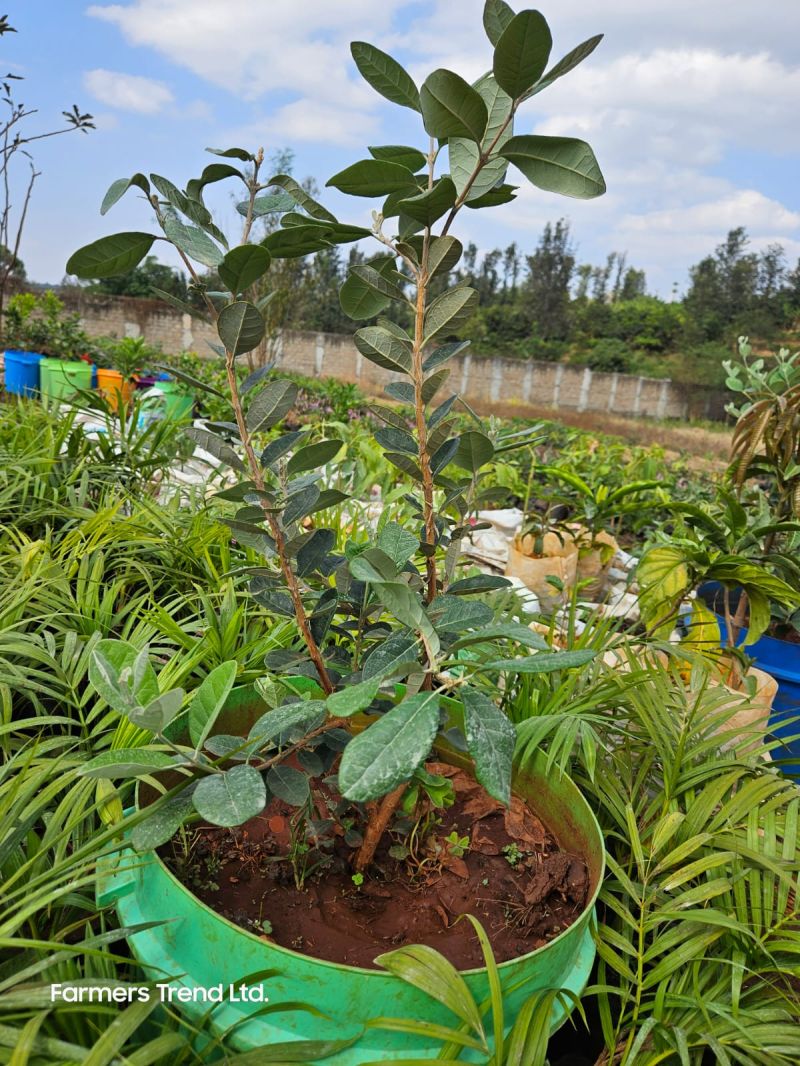
Pineapple Guava Seedlings (Feijoa)
Original price was: KSh 7,000.00.KSh 3,500.00Current price is: KSh 3,500.00.
Buy Certified Grafted Pineapple Guava Seedlings in Kenya from Farmers Trend Limited

Introduction
Finding the right Pineapple Guava Seedlings is the first and most important step when establishing a productive orchard. Healthy seedlings develop into strong trees, begin producing earlier, and continue yielding quality fruits for many years. Poor quality seedlings often result in weak growth, slow establishment, inconsistent fruit quality, and unnecessary replacement costs. The success of your investment begins with choosing the right nursery.
Farmers Trend Limited produces certified Grafted Pineapple Guava Seedlings for farmers across Kenya. Every seedling is propagated from carefully selected mother trees and grafted using proven nursery techniques to produce vigorous trees with excellent growth, healthy root systems, and consistent fruit quality. Our seedlings are suitable for commercial orchards, home gardens, institutions, schools, county government projects, hotels, agroforestry projects, and fruit farmers looking to diversify into premium fruit production.
Each certified Grafted Pineapple Guava Seedling costs KSh 3,500.
Unlike many common fruit trees, Pineapple Guava, also known as Feijoa, remains a premium fruit with limited commercial production in Kenya. This creates an opportunity for farmers who want to grow a unique fruit with increasing consumer demand. As more supermarkets, hotels, restaurants, fruit shops, and health-conscious consumers look for high-quality fresh fruits, Pineapple Guava continues attracting attention because of its pleasant aroma, sweet tropical flavour, attractive appearance, and excellent nutritional value.
This guide explains everything you need to know before buying Pineapple Guava Seedlings in Kenya. You will learn why grafted seedlings perform better than ordinary seedlings, how Farmers Trend Limited produces healthy planting material, where Pineapple Guava grows best in Kenya, how to establish a productive orchard, and what to expect during the first years after planting.
Why Buy Grafted Pineapple Guava Seedlings Instead of Seed-Grown Trees?
One of the most common mistakes made by first-time growers is purchasing seedlings propagated directly from seed. Although seed-grown trees survive, they rarely produce uniform orchards. Some trees grow vigorously while others remain small. Fruit size, flavour, productivity, maturity period, and tree shape often vary because seedlings inherit different characteristics.
Commercial fruit production requires consistency.
A grafted Pineapple Guava seedling combines two carefully selected plants into one healthy tree. The upper section, known as the scion, comes from a mature mother tree selected for excellent fruit quality, reliable production, and vigorous growth. The lower section, known as the rootstock, provides strength, healthy root development, and adaptability to different soil conditions.
The result is a tree that grows more uniformly and performs more consistently than ordinary seedlings.
Farmers establishing commercial orchards prefer grafted seedlings because every tree develops in a similar way. Uniform orchards simplify irrigation, pruning, fertiliser application, spraying, harvesting, and long-term orchard management. Healthy grafted trees also reduce the number of poor-performing trees that require replacement during the first few years.
Although grafted seedlings require a higher initial investment than ordinary seedlings, they provide greater confidence that every tree planted contributes to the productivity of the orchard.
Why Farmers Trend Limited Produces Grafted Pineapple Guava Seedlings
At Farmers Trend Limited, we believe the quality of a fruit orchard is determined long before planting begins.
Every Pineapple Guava seedling starts with the careful selection of healthy mother trees. Only trees with vigorous growth, good fruit quality, consistent production, and desirable characteristics are used for propagation. This helps maintain quality throughout every generation of seedlings produced at our nursery.
Our nursery team carries out grafting under controlled conditions to encourage proper healing between the rootstock and the scion. During this period, every seedling receives regular watering, nutrition, pest monitoring, disease management, and routine inspections.
Seedlings are not supplied immediately after grafting. They remain in the nursery until healthy root systems, vigorous shoots, and strong graft unions have fully developed.
Before leaving our nursery, every seedling is inspected to ensure it meets our quality standards. We check stem strength, leaf health, root development, graft union healing, and overall plant vigour.
This attention to detail helps farmers establish orchards with healthy, uniform trees capable of producing quality fruits for many years.
Why Pineapple Guava Is Becoming Popular in Kenya
Many Kenyan farmers are looking beyond traditional fruit crops and exploring new opportunities that offer premium market prices and less competition.
Pineapple Guava fits this category well.
The fruit has a unique flavour combining the sweetness of pineapple with the freshness of guava and subtle mint-like notes. This distinctive taste attracts consumers looking for something different from ordinary fruits.
Fresh Pineapple Guava fruits are enjoyed on their own or used in fruit salads, juices, smoothies, desserts, yoghurt, ice cream, cakes, jams, wines, and preserves. The fruit is also popular among chefs because of its pleasant aroma and attractive presentation.
As demand for premium fruits grows, Pineapple Guava continues attracting interest from supermarkets, hotels, restaurants, specialty fruit shops, and individual consumers.
Unlike many fruits already widely grown across Kenya, Pineapple Guava remains relatively scarce. Limited production means farmers have an opportunity to supply markets with less direct competition.
Product Specifications
Choosing the right planting material begins with understanding exactly what you are buying.
| Specification | Description |
|---|---|
| Product Name | Grafted Pineapple Guava Seedling |
| Common Name | Pineapple Guava |
| Botanical Name | Acca sellowiana |
| Other Name | Feijoa |
| Plant Type | Certified Grafted Fruit Seedling |
| Price | KSh 3,500 per seedling |
| Recommended Spacing | 4 metres × 3 metres |
| Trees Per Acre | Approximately 450 trees |
| Productive Life | More than 25 years under good management |
| Suitable Uses | Commercial orchards, home gardens, institutions, agroforestry and mixed fruit farms |
| Nursery | Farmers Trend Limited |
Why Farmers Buy Pineapple Guava Seedlings from Farmers Trend Limited
Buying a fruit seedling is more than purchasing a plant. It is the beginning of a long-term investment that may remain productive for decades.
Farmers Trend Limited supports growers before, during, and after planting.
Our customers receive guidance on site selection, orchard planning, spacing, planting, irrigation, pruning, fertiliser application, pest management, harvesting, and orchard maintenance. This technical support helps farmers establish healthy orchards with greater confidence.
We supply seedlings to individual farmers, commercial farms, institutions, schools, county governments, landscape projects, hotels, and agricultural organisations across Kenya.
Our nursery has earned the confidence of customers because we focus on producing healthy planting materials rather than simply selling seedlings.
When customers visit our nursery, they are encouraged to inspect the seedlings before purchase. Healthy roots, vigorous stems, healthy foliage, and properly healed graft unions are all signs of quality planting material.
We also arrange deliveries to different parts of Kenya, allowing farmers to establish orchards without travelling long distances to collect seedlings.
Who Should Buy Pineapple Guava Seedlings?
Pineapple Guava is suitable for both small-scale and commercial production.
Farmers looking to diversify their fruit enterprises often add Pineapple Guava alongside avocado, citrus, macadamia, loquat, white sapote, persimmon, peaches, plums, and apples.
Institutions establishing demonstration farms also benefit from introducing unique fruit species that expose students and farmers to new commercial opportunities.
Homeowners looking for attractive fruit trees appreciate Pineapple Guava because it combines ornamental beauty with fruit production.
Commercial investors value the crop because of its long productive life and premium market positioning.
Why the Price Reflects Long-Term Value
A certified Grafted Pineapple Guava Seedling from Farmers Trend Limited costs KSh 3,500.
Some buyers compare this price with ordinary seed-grown seedlings and wonder why grafted seedlings cost more.
The answer lies in the amount of work involved in producing every healthy grafted tree.
Selecting superior mother plants, raising vigorous rootstocks, carrying out successful grafting, managing seedlings during healing, monitoring growth, and inspecting every plant before sale all require skilled labour, time, and careful nursery management.
A Pineapple Guava tree remains productive for many years. Investing in quality planting material at the beginning often saves farmers from future losses associated with poor-quality seedlings.
Healthy seedlings establish faster, require fewer replacements, and provide a stronger foundation for a productive orchard.
Ecological Requirements for Growing Pineapple Guava (Feijoa) in Kenya
Choosing the right growing environment is one of the most important decisions before buying Pineapple Guava Seedlings. Even the healthiest grafted seedlings will struggle if planted under unsuitable conditions. Before establishing an orchard, evaluate your altitude, rainfall, temperature, soil type, and access to water. Doing this before planting helps you avoid costly mistakes and gives your orchard the best chance of producing quality fruits for many years.
Pineapple Guava is more tolerant of cool conditions than many tropical fruit crops. This makes it an excellent choice for farmers living in Kenya’s highland regions where crops such as mango or citrus may not perform as well.
Altitude
Pineapple Guava grows best between 1,200 and 2,500 metres above sea level.
Within this altitude range, trees produce vigorous growth, abundant flowers, healthy fruits, and good flavour development.
The crop performs particularly well between 1,500 and 2,200 metres above sea level, where temperatures remain moderate throughout the year.
At lower elevations where temperatures remain high for long periods, flowering reduces and fruit quality declines. Excessive heat also increases water requirements and places young trees under stress.
Temperature
Temperature affects flowering, fruit set, fruit size, sweetness, and overall tree health.
The ideal temperature ranges between 15°C and 26°C.
Moderate temperatures encourage continuous shoot development, healthy flowering, and gradual fruit enlargement.
Young trees tolerate cool nights better than many tropical fruit crops.
Unlike citrus, Pineapple Guava tolerates occasional light frost once mature, making it suitable for several cool regions of Kenya.
Prolonged temperatures above 30°C reduce flowering and increase moisture loss from the leaves. Young trees growing under hot conditions require regular irrigation until their root systems become fully established.
Rainfall
Annual rainfall between 800 mm and 1,500 mm provides suitable growing conditions.
Rainfall should be distributed throughout the year rather than falling within only a few months.
Consistent soil moisture supports healthy shoot growth, flowering, fruit development, and fruit size.
Long dry periods reduce flowering and cause developing fruits to drop before maturity.
Where rainfall becomes unreliable, drip irrigation maintains steady growth and improves fruit quality.
Excessive rainfall combined with poor drainage encourages root diseases and reduces oxygen around the root system.
Sunlight
Pineapple Guava requires full sunlight throughout the day.
Trees planted in shaded areas produce fewer flowers and lower yields because sunlight drives photosynthesis and fruit development.
Choose land receiving at least eight hours of direct sunshine every day.
Avoid planting close to large trees that compete for sunlight, water, and nutrients.
Proper sunlight also improves fruit colour, flavour, and sugar development.
Wind
Strong winds damage young trees by breaking tender shoots and reducing flower retention.
Wind also increases moisture loss during dry weather.
Where the farm is exposed to strong winds, establish windbreak trees before planting the orchard.
Suitable windbreaks include Grevillea robusta and Casuarina species planted around the farm boundary without shading the orchard.
Soil Requirements
Healthy soils support healthy orchards.
Pineapple Guava grows best in deep, fertile, well-drained loam or sandy loam soils rich in organic matter.
Roots require both moisture and oxygen.
Heavy clay soils remain wet for long periods after rainfall, reducing oxygen around the roots and encouraging root diseases.
Very shallow soils restrict root expansion and reduce drought tolerance.
Adding well-decomposed organic manure before planting improves soil structure, moisture retention, and microbial activity while supplying nutrients needed during early establishment.
Soil pH
The recommended soil pH ranges between 5.5 and 6.8.
Soils that are too acidic reduce nutrient availability and slow tree growth.
Highly alkaline soils also limit nutrient uptake.
Before purchasing seedlings, carry out a soil analysis to determine soil pH, nutrient levels, and organic matter content.
Correcting soil problems before planting is easier and less expensive than correcting them after establishing the orchard.
Water Requirements
Although mature Pineapple Guava trees tolerate short dry periods better than many fruit crops, young trees require consistent moisture.
The first two years after planting are critical.
Water stress during this period slows root development and delays tree establishment.
Where rainfall is insufficient, drip irrigation provides the most efficient watering method because it delivers moisture directly to the root zone while reducing evaporation losses.
Avoid overwatering because continuously saturated soils encourage root diseases.
Healthy root development depends on maintaining moist but well-drained soil.
Best Areas to Grow Pineapple Guava in Kenya
Pineapple Guava performs exceptionally well in Kenya’s cool and moderate highland regions.
Farmers in these areas benefit from temperatures that favour flowering, fruit development, and fruit quality.
Suitable counties include Murang’a, Kiambu, Nyeri, Kirinyaga, Embu, Meru, Nyandarua, Nakuru, Laikipia, Kericho, Nandi, Uasin Gishu, Elgeyo Marakwet, Trans Nzoia, Bungoma, Kisii, Nyamira, Bomet, parts of Narok, Nyandarua, and the cooler parts of Machakos.
The crop also performs well in many private farms located around Limuru, Tigoni, Kieni, Molo, Njoro, Timau, Mau Narok, and other cool agricultural zones.
Farmers in warmer counties are encouraged to consult our agronomists before planting. Site selection, irrigation, and local climate conditions determine whether the crop will perform well.
Planning Your Orchard Before Buying Seedlings
Successful orchards begin with proper planning.
Many farmers purchase seedlings before preparing their land. This often delays planting and exposes young seedlings to unnecessary stress.
At Farmers Trend Limited, we recommend preparing the land before collecting or receiving your seedlings.
The orchard should already be cleared, planting holes dug, manure prepared, and irrigation planned before the seedlings arrive.
This allows immediate transplanting and reduces transplant shock.
Orchard Layout and Spacing
Proper spacing improves tree growth and makes orchard management easier throughout the life of the plantation.
Farmers Trend Limited recommends planting Grafted Pineapple Guava Seedlings at a spacing of 4 metres by 3 metres.
This spacing accommodates approximately 450 trees per acre.
The arrangement allows adequate sunlight penetration, proper air circulation, easier pruning, and convenient movement during harvesting, spraying, irrigation, and routine orchard management.
Crowded orchards produce excessive shade, encourage diseases, reduce fruit quality, and make harvesting difficult.
Estimating Seedling Requirements
Before ordering seedlings, calculate the exact number required.
| Orchard Size | Recommended Spacing | Number of Seedlings |
|---|---|---|
| ¼ Acre | 4 m × 3 m | Approximately 112 |
| ½ Acre | 4 m × 3 m | Approximately 225 |
| 1 Acre | 4 m × 3 m | Approximately 450 |
| 2 Acres | 4 m × 3 m | Approximately 900 |
| 5 Acres | 4 m × 3 m | Approximately 2,250 |
Each Grafted Pineapple Guava Seedling costs KSh 3,500.
For a one-acre orchard requiring approximately 450 seedlings, the estimated investment in planting material is KSh 1,575,000.
Although the initial investment appears significant, Pineapple Guava is a long-term crop capable of producing fruits for many years when properly managed.
Farmers establishing larger orchards are encouraged to contact Farmers Trend Limited for production planning, delivery arrangements, and technical support before planting.
Step by Step Guide to Planting Grafted Pineapple Guava Seedlings
Purchasing healthy Pineapple Guava Seedlings is only the beginning. The first few weeks after planting determine how quickly the trees establish and how productive the orchard becomes in the years ahead. Proper handling during transportation, careful planting, regular watering, and close monitoring help young trees develop strong root systems capable of supporting vigorous growth and high fruit production.
At Farmers Trend Limited, we advise farmers to complete all land preparation before the seedlings arrive. Planting immediately after delivery reduces transplant stress and allows the trees to begin establishing without unnecessary delays.
Transporting Your Seedlings
Transport seedlings in an upright position to prevent stems from bending or breaking. Avoid stacking heavy objects on top of the plants because this damages the leaves and weakens the graft union.
If the journey is long, protect the seedlings from strong winds and direct sunlight. Excessive heat causes moisture loss and increases transplant shock.
Upon arrival, unload the seedlings carefully and place them under partial shade if planting will not take place immediately.
Temporary Storage Before Planting
Sometimes weather conditions or farm preparation delay planting by a few days.
During this period, keep the seedlings in a cool location where they receive morning sunlight and afternoon shade.
Water them lightly every day to keep the growing media moist.
Do not leave seedlings inside vehicles overnight or expose them to direct afternoon sunshine.
If planting is delayed for more than one week, continue watering regularly and inspect the seedlings for pests or signs of stress.
Land Preparation
Good orchards begin with proper land preparation.
Clear all bushes, shrubs, perennial weeds, and unwanted vegetation.
Deep plough the land if it has been under cultivation for many years or has compacted soil.
Carry out soil analysis before planting. Soil testing identifies nutrient deficiencies, soil acidity, and organic matter levels, allowing corrections before the trees are established.
Mark the planting positions using the recommended spacing of 4 metres by 3 metres.
Straight planting lines simplify irrigation installation, mowing, pruning, harvesting, and movement within the orchard.
Digging Planting Holes
Dig planting holes measuring approximately 60 cm long, 60 cm wide, and 60 cm deep at least three weeks before planting.
Separate the fertile topsoil from the subsoil.
Mix the topsoil thoroughly with 20 to 30 kilograms of well-decomposed farmyard manure before returning it to the planting hole.
Fresh manure should never be used because it generates heat during decomposition and damages young roots.
Water the prepared holes if the soil is dry before planting.
Planting the Seedlings
Water the seedlings before removing them from their nursery containers.
Carefully remove the container without disturbing the root ball.
Place the seedling upright in the centre of the planting hole.
The graft union must remain above the soil surface. Planting below the graft union encourages diseases and weakens the tree.
Backfill the hole using the prepared topsoil while gently pressing the soil around the roots to eliminate air pockets.
Form a shallow basin around the tree to hold irrigation water.
Water immediately after planting using approximately 15 to 20 litres of clean water per tree.
Staking Young Trees
Young Pineapple Guava trees benefit from staking during the first year.
Drive a strong wooden stake into the ground beside each seedling and tie the stem loosely using soft tying material.
The stake protects the young tree against strong winds and encourages upright growth.
Inspect the ties regularly to prevent them from cutting into the stem as the tree grows.
Mulching
Apply a layer of dry grass, dry leaves, or other organic mulch around every tree.
Leave a gap of about 15 centimetres around the stem to prevent moisture from accumulating against the trunk.
Mulching conserves soil moisture, suppresses weeds, moderates soil temperature, and gradually improves soil organic matter as it decomposes.
Watering During Establishment
Young Pineapple Guava trees require regular watering until they establish strong roots.
During dry weather, irrigate once or twice every week depending on soil type and weather conditions.
Sandy soils require more frequent watering than clay soils because they lose moisture faster.
Avoid overwatering because waterlogged soil encourages root diseases.
Drip irrigation is the most efficient watering method for commercial orchards because it supplies water directly to the root zone while reducing wastage.
Weed Management
Weeds compete with young trees for nutrients, water, and sunlight.
Keep the area around every tree free from weeds, especially during the first two years.
Hand weeding, shallow cultivation, and mulching are effective methods of weed control.
Avoid deep cultivation near the tree because Pineapple Guava develops shallow feeder roots that are easily damaged.
Pruning Young Trees
Pruning begins soon after establishment.
Remove broken branches, weak shoots, and any suckers developing below the graft union.
The objective during the first years is to develop a strong framework capable of supporting heavy fruit loads.
Good pruning also improves air circulation and sunlight penetration throughout the canopy.
Pest and Disease Monitoring
Inspect the orchard every week.
Early detection prevents small problems from becoming expensive outbreaks.
Monitor leaves, stems, flowers, and developing fruits for unusual spots, insect damage, or abnormal growth.
Healthy seedlings from Farmers Trend Limited provide an excellent start, but regular field inspections remain important throughout the life of the orchard.
Production Potential Per Acre
Pineapple Guava is a long-term investment rather than a quick-return crop.
Young trees spend the first few years establishing healthy root systems and building strong canopies.
Commercial fruit production increases steadily as the orchard matures.
Under proper management, mature trees commonly produce between 20 and 35 kilograms of fruits per tree each year.
At the recommended population of approximately 450 trees per acre, this represents an estimated annual production of 9,000 to 15,750 kilograms of fruits per acre.
Actual production depends on rainfall, irrigation, pollination, soil fertility, pruning, pest management, and overall orchard care.
Profitability Per Acre
Pineapple Guava remains a premium fruit with attractive market opportunities.
The example below illustrates how production influences gross income.
| Item | Estimate |
|---|---|
| Trees per acre | 450 |
| Average production per tree | 25 kg |
| Total production | 11,250 kg |
| Example selling price | KSh 120 per kg |
| Estimated Gross Income | KSh 1,350,000 per year |
These figures represent an example based on the assumptions above. Actual income varies depending on orchard management, fruit quality, seasonal supply, and the market where the fruit is sold.
Farmers who supply supermarkets, hotels, fruit processors, and specialty retailers often achieve better returns than those selling through brokers.
Marketing Opportunities
Pineapple Guava has diverse market opportunities because of its unique flavour and nutritional value.
Fresh fruits are purchased by supermarkets, grocery stores, hotels, restaurants, schools, fruit vendors, and individual consumers.
The fruit is also suitable for processing into juices, smoothies, jams, jellies, desserts, yoghurt, ice cream, wines, and confectionery products.
As awareness of the fruit continues to grow in Kenya, demand is expected to increase among consumers seeking premium and healthy fruit options.
Farmers who focus on quality production, proper harvesting, grading, and packaging are better positioned to access premium markets.
Why Farmers Choose Farmers Trend Limited
Farmers Trend Limited is committed to supplying high-quality grafted fruit seedlings backed by professional technical support.
Our nursery has supplied fruit seedlings to farmers, institutions, county governments, schools, NGOs, and commercial farms across Kenya.
Every Grafted Pineapple Guava Seedling is produced using carefully selected mother trees and managed under strict nursery standards to ensure healthy root development, vigorous growth, and successful establishment after transplanting.
Beyond supplying seedlings, we guide farmers on orchard planning, spacing, planting, irrigation, nutrition, pruning, pest and disease management, and long-term orchard care.
Our goal is not only to sell seedlings but also to help farmers establish productive orchards that remain profitable for many years.
Frequently Asked Questions
Many farmers ask how long Pineapple Guava takes to produce fruit. Grafted trees generally begin producing earlier than seed-grown trees, although the exact timing depends on management and environmental conditions.
Another common question is whether Pineapple Guava grows well alongside other fruit trees. The answer is yes. It fits well into mixed fruit orchards with crops such as avocado, macadamia, citrus, loquat, white sapote, and persimmon, provided each crop is given adequate spacing and sunlight.
Farmers also ask whether the crop requires irrigation. Mature trees tolerate short dry periods better than many fruit crops, but irrigation during establishment and prolonged drought greatly improves growth, flowering, and fruit production.
Conclusion
Pineapple Guava is one of the most promising premium fruit crops for farmers seeking a long-term investment with growing market demand. Success begins with selecting healthy grafted seedlings, establishing the orchard correctly, and maintaining good management practices throughout the life of the trees.
At Farmers Trend Limited, we produce certified Grafted Pineapple Guava Seedlings from carefully selected mother trees to help farmers establish healthy, productive orchards. Every seedling is raised under professional nursery management and supported by expert agronomic advice to give you the best possible start.
Whether you are planting a few trees in your home garden or establishing a commercial orchard, investing in quality planting material is one of the most important decisions you will make. Healthy seedlings form the foundation of healthy trees, consistent fruit production, and long-term profitability.
Certified Grafted Pineapple Guava (Feijoa) Seedlings are available at KSh 3,500 per seedling.
For orders, orchard planning, and technical advice, contact:
Farmers Trend Limited
Phone: 0790 509 684
Phone: 0724 559 286
Email: info@farmerstrend.co.ke
Website: www.farmerstrend.co.ke
Location: Murang’a, Kenya
General Inquiries
There are no inquiries yet.
Related products
Grapes Seedlings
Original price was: KSh 500.00.KSh 300.00Current price is: KSh 300.00.Select options This product has multiple variants. The options may be chosen on the product pageOur grapes seedlings are sourced from farms with a rich history and proven track record in grape production. These farms have been meticulously cultivating grapes for years, honing their techniques to yield high-quality, robust vines. By leveraging their expertise and commitment to excellence, we ensure that our seedlings inherit these superior traits, setting you up for success in your grape farming journey.
Cherry Guava Seedlings
Original price was: KSh 800.00.KSh 600.00Current price is: KSh 600.00.Add to cartCherry Guava (Psidium cattleianum), also known as Strawberry Guava, is a vibrant red or yellow guava variety that has gained popularity in Kenya due to its sweet taste and nutritional value. We offer high-quality Cherry Guava seedlings that are perfect for both small-scale and large-scale farming.
Canistel / Egg Fruit Seedlings
Original price was: KSh 5,000.00.KSh 3,000.00Current price is: KSh 3,000.00.Add to cartAre you looking to add a unique, nutrient-rich fruit to your farm or home garden? Look no further than the Canistel (commonly known as Egg Fruit), an exotic fruit tree that thrives in tropical climates like Kenya’s. At Farmers Trend Online Virtual Agrovet, we offer high-quality, well-hardened Canistel/Egg Fruit seedlings that are ready for planting and will bring you bountiful harvests.
Grafted Apple Seedlings
Original price was: KSh 1,000.00.KSh 600.00Current price is: KSh 600.00.Select options This product has multiple variants. The options may be chosen on the product pageGrafted Apple Seedlings sold at our nursery are grafted from the best rootstock of M9, this rootstock is a sure bet when it comes to apple farming in Kenya.
Our seedlings are certified and boast a 99% survival rate, thanks to our meticulous grafting process using the superior M9 rootstock. Let’s look into why our grafted apple seedlings are the top choice for Kenyan farmers.


Featured Products
- Knapsack Sprayer Pump Price range: KSh 3,900.00 through KSh 8,250.00
- Metallic Garden Rake with Handle Original price was: KSh 2,400.00.KSh 1,200.00Current price is: KSh 1,200.00.
- Coopers Triatix Stock Spray Price range: KSh 107.00 through KSh 315.00
- Poultry chicken Feeder Price range: KSh 270.00 through KSh 1,480.00
- SC Sungura 301 Maize Seed Original price was: KSh 590.00.KSh 530.00Current price is: KSh 530.00.
- Maclik Super Cow Salt Price range: KSh 150.00 through KSh 530.00
- Coopers Milking Salve Price range: KSh 60.00 through KSh 1,370.00
- Standard Heavy Duty Wheelbarrow Original price was: KSh 9,500.00.KSh 8,400.00Current price is: KSh 8,400.00.
- Giant Nightshade (Managu) Price range: KSh 250.00 through KSh 350.00
- CORIANDER DANIA SEEDS - 250G Original price was: KSh 1,250.00.KSh 965.00Current price is: KSh 965.00.


Reviews
There are no reviews yet.